

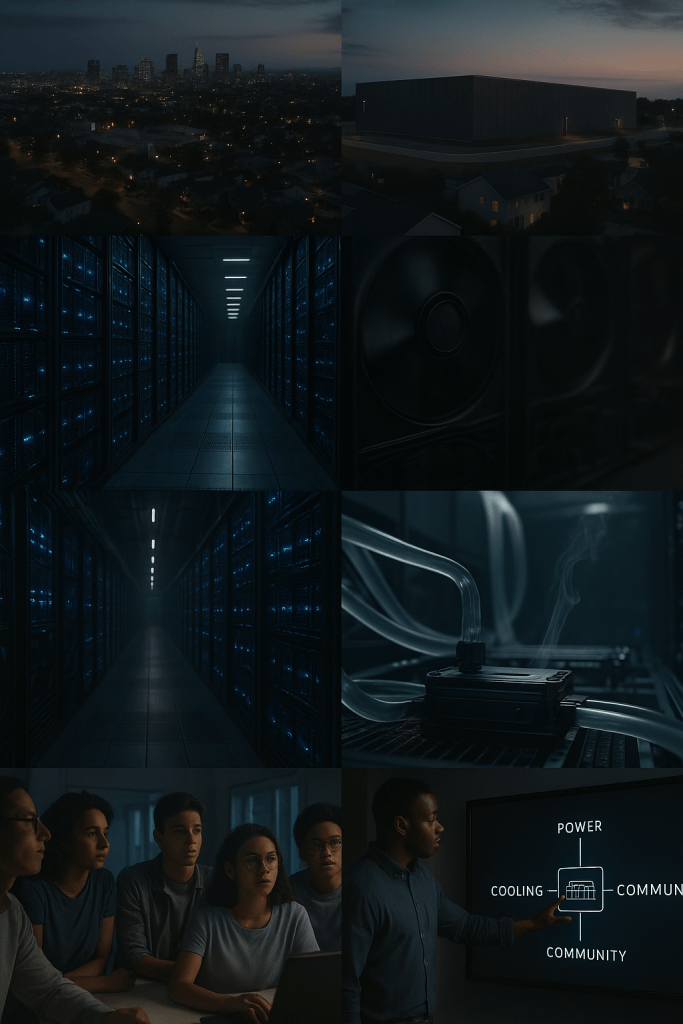
People like to say that artificial intelligence lives in the cloud as if it is light, weightless, somewhere above all of us.
In reality, AI lives in rooms filled with racks and cables.
It lives on land that belongs to somebody.
It pulls energy from grids that already sit atop communities that have borne the weight of industry before.
AI does not float.
AI is heavy.
That is why a conversation about liquid cooling for AI data centers is not just about hardware. It is about power, planning, and whether the communities that have always paid the highest cost will be locked out of the next wave again.
The Heat Problem Is A Power Problem
Right now, AI data centers are consuming energy at a scale that is beginning to stress local and national grids. Federal estimates project that in the coming years, American data centers could use a substantial share of the nation’s electricity.
This is not just a tech statistic. It is a public policy number.
Traditional air cooling systems were never designed for this level of compute density. Large fans, vents, and HVAC systems are fighting a losing battle against the concentrated heat generated by high-performance chips stacked closely together.
Liquid cooling changes that dynamic.
Instead of fighting heat with more air and more energy, liquid cooling:
- Moves heat away from chips more efficiently
- Allows higher compute density in smaller spaces
- Reduces the energy required to keep systems within safe operating temperatures
If a nation wants to lead in AI, it must modernize the physical and energy infrastructure that supports AI. There is no version of AI leadership built on broken foundations.
What This Means For Education And Special Education
At first glance, liquid cooling sounds like a topic for engineers and utility planners. Once you sit with it, you begin to see clear implications for schools, families, and students with disabilities.
Stronger, more efficient AI infrastructure unlocks new possibilities:
1. Access To More Powerful Tools For Schools
Districts will not build their own data centers. That is not realistic. They will, however, plug into systems and platforms that rely on large-scale compute.
Better cooling and energy efficiency lower long-term operational costs for AI providers. Over time, this can translate into more accessible tools for Education, including for smaller districts and under-resourced schools.
2. Real AI Support For Special Education
Special Education has often been the last to benefit from technological change.
Yet the work of SPED is deeply data-driven:
- Evaluations
- IEPs
- Progress monitoring
- Accommodations and modifications
- Transition planning
AI tools that can support educators and families in these areas are inherently compute-intensive. They need to analyze text, history, patterns, and outcomes.
Improved infrastructure makes it more feasible to build and scale tools that:
- Suggest goals and present levels based on real data
- Recommend accommodations and modifications
- Package information for families in clearer, more accessible ways
- Assist with compliance while preserving humanity in the process
This is the lane my work with Thoughts Cost and AI-driven SPED tools aims to occupy.
3. New Training Pathways For Students
As AI infrastructure evolves, there will be a growing demand for:
- Technicians who understand cooling and maintenance
- Engineers who design sustainable systems
- Policy leaders who can connect technology and community impact
Community colleges, trade programs, and universities can build pathways that connect students, especially those from historically marginalized communities, to these careers.
Students should learn that AI is not just about prompts. It is also about power, cooling, land, and responsibility.
The Real Question: Who Benefits Inside The United States
Nationally, there is a clear desire to keep the United States at the forefront of AI development. Efficient data centers and advanced cooling are a key part of that strategy.
Here is the pattern:
If you cannot cool it, you cannot scale it.
If you cannot scale it, you cannot control it.
If you cannot control it, you cannot profit from it.
That is the geopolitical layer.
There is another layer underneath that matters just as much:
Not simply “Will America lead in AI?”
The deeper question is “Which communities inside America will benefit from AI infrastructure and investment?”
History tells us that technology booms rarely distribute their benefits evenly. Data centers, like highways and industrial plants before them, will land in specific locations.
Communities, educators, and advocates must begin asking:
- Where will these facilities be located?
- Who will gain jobs, training, and long-term opportunities?
- Who will absorb environmental and grid impacts?
- How can education systems prepare students to participate in this new infrastructure economy?
Where I Stand In This Shift
Through my work in Special Education, transition services, and AI development, I see liquid cooling and AI infrastructure as more than a technical story.
It is a chance to:
- Design tools that serve students with disabilities and their families
- Develop a curriculum that teaches young people about the physical reality of AI
- Build partnerships with universities, districts, and community organizations
- Advocate for policies that align AI growth with justice and inclusion
Highways defined the industrial era.
Broadband defined the early internet era.
AI infrastructure will define the era we are entering now.
Whoever controls and shapes that infrastructure will shape a significant part of our future.
My goal is to make sure our communities and our students with disabilities are not standing outside that future, looking through the glass.
They deserve a seat at the table.
They deserve tools that work for them.
They deserve to be part of the design.
 Thoughts Processed