

I saw that Mike Bibby clip and I felt two things at the same time, the way you do when you’ve actually lived inside the system people argue about from the outside.
First, the obvious truth: college basketball has always been a business. Always. The adults were getting paid, the buildings were getting built, the contracts were getting signed, the TV windows were getting negotiated, the “student athlete” label getting polished like it was some sacred phrase. Meanwhile, the players were expected to be grateful for a scholarship, as if gratitude is supposed to cover groceries back home, cover the rent, cover the fact that your body is the product and your time is the inventory.
Second, another truth that doesn’t disappear just because money finally entered the room in an official way: there are principles and values in basketball that should not be for sale. Those values are not old-fashioned; they’re the whole point of the sport. Compete. Earn it. Be coachable. Be accountable. Respect the work. Respect the locker room. Respect the idea that nothing is promised and everything is taken.
This is where folks talk past each other.
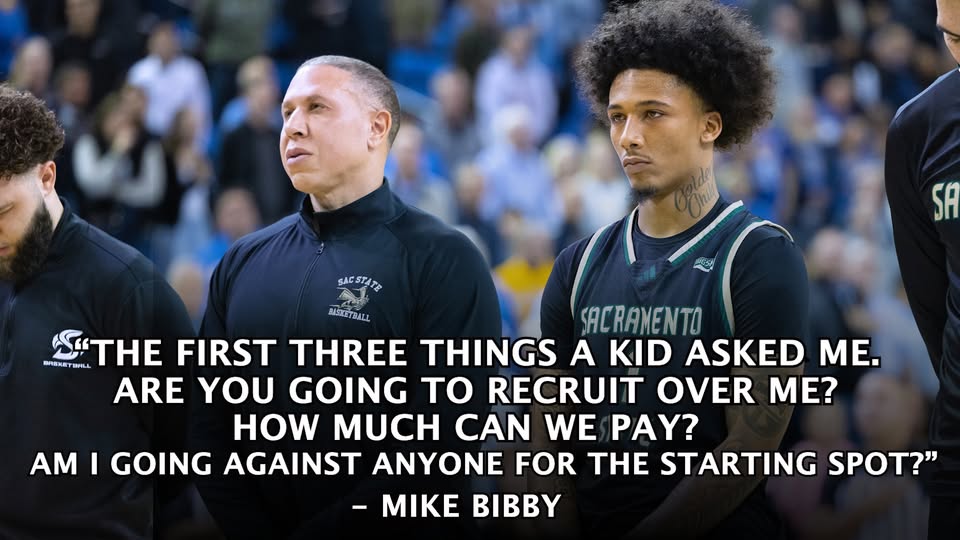
People hear Bibby saying, “Kids ask about money first,” and they respond like he’s trying to drag us back to the plantation version of college sports, where the player is supposed to shut up, play hard, and smile for the brochure. That’s not what I’m hearing. I’m hearing a coach saying, “If the first thing you want to know is what you’re getting, and the second thing you want to know is whether I’m recruiting over you, and the third thing you want to know is whether you’re guaranteed a starting spot, then you’re telling me what you value, and it isn’t the work.”
Those are not the same conversation.
Plenty of us who played in college, especially those of us who had to grow up fast, understand the value of asking hard questions. You should ask about development, about the plan, about the role, about the support system, about education, about how they treat injuries, about what happens when the shots stop falling. You should ask about NIL too, because bills are real and careers are short.
Still, the order matters. The posture matters.
A player walking in with a businessman’s questions can be wise. A player walking in with a customer’s entitlement is poison. Those are two different energies.
What’s getting lost in the NIL and portal era is that the game still demands humility in the face of competition. Basketball is not a right; it’s a daily tryout. The starting spot is not an entitlement; it’s a responsibility you take from someone else and then defend every single day. Every player who ever mattered learned that lesson, whether they learned it in silence or learned it from a coach getting on them so hard it felt personal.
Coaches still get fired when they don’t do the job. That’s real. Universities still cut checks, boosters still panic, fanbases still turn, and athletic directors still make a call like they’re ordering lunch. Nobody protects a coach’s feelings when the wins dry up.
So if we’re going to say “This is business now,” then let’s go all the way with it.
Business means performance. Business means accountability. Business means you do not get to skip the hard parts and still collect the benefit. Business means if you don’t defend, if you don’t show up in the weight room, if you don’t buy into what winning requires, you sit. Business means the scholarship is not the only contract in the room anymore, because the program is also investing NIL dollars and reputation and opportunity cost.
The problem is not that players have leverage. Players needed leverage. The problem is that too many spaces feeding the pipeline have been teaching kids that leverage is the same thing as greatness.
AAU culture can turn a teenager into a brand before he becomes a player. High school highlights can make a kid believe the game is something you perform, not something you learn. Social media can make “respect” feel like likes. Adults can make it worse, gassing up potential while ignoring habits, calling a kid “him” before he can guard the ball or handle coaching.
That’s how you end up with a generation of players who confuse options with identity.
Options are not character. Options are not discipline. Options are not love of the craft.
Bibby’s line about coaches being scared to coach is the part nobody wants to touch, because it forces an uncomfortable question: what happens to a sport built on correction, when correction becomes negotiable?
A coach who is afraid of losing a “superstar” to the next AAU handler, the next recruiter, the next portal offer, is a coach who starts bargaining with standards. The superstar senses it immediately. The rest of the locker room feels it even faster. Then you don’t have a program, you have a talent showcase with uniforms.
That’s how the game gets ruined, not because kids get paid, but because the culture stops teaching them how to become the kind of player worth paying.
Love of the game used to mean you loved the boring parts too. The repetitions. The criticism. The film. The conditioning. The defensive stance when your legs are burning and nobody is filming you. The pass to the open man when your shot is the one that gets attention. The humility of being coached hard and still coming back tomorrow.
Money doesn’t have to kill that. Weak standards kill that.
This era needs grown-up structures to match grown-up realities. Contracts. Clear expectations. Real development plans. Transparent roles, with the understanding that roles can change when the work changes. Schools protecting themselves, players protecting themselves, everybody acting like professionals because the stakes are professional now.
Most importantly, this era needs adults brave enough to teach again.
Teach the kid that the first question should be, “What do you demand from your guards?” Teach the kid that the second question should be, “How do you develop players like me?” Teach the kid that money can be part of the conversation without being the whole conversation. Teach the kid that competing for a spot is not disrespect, it’s basketball.
NIL didn’t invent selfishness. The portal didn’t invent impatience. Those things just exposed what we were already allowing.
So yes, pay the players. Pay them openly, fairly, and without the fake morality.
Then demand the things the game has always demanded: effort, sacrifice, accountability, and the willingness to be coached.
Those values are not nostalgia. Those values are the sport.
 Thoughts Processed