

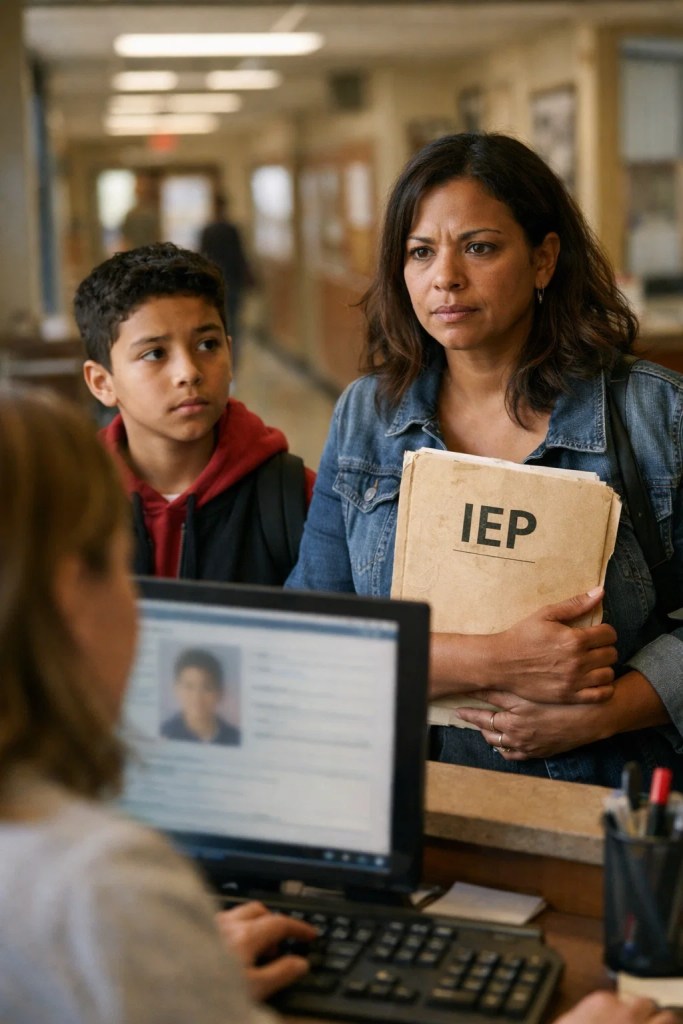
A student transfers schools on a Tuesday, right in the middle of a unit test week. The parent arrives with a folder, a memory of meetings that took months to schedule, and one clear request, “My child has an IEP, services cannot stop.”
The receiving school does what it is trained to do. Staff request records, someone emails the prior site, the registrar starts a new enrollment packet, and the special education case manager searches the SPED system.
Then, the first failure happens before anyone notices, and the student becomes two students.
Not in the classroom, in the data.
Once identity splits, everything downstream begins to wobble. Minutes get delayed, transportation misses the accommodation note, providers cannot see the most current goals, progress reports pull the wrong student, Medicaid claims fail, and compliance clocks start ticking with missing context. People experience this as a technology problem, yet the core issue is a systems problem, a decision problem, a governance problem, a values problem.
This work is fixable, and it does not require buying another platform.
The Myth of the Broken API
What districts think is failing
Districts often blame the interface. The API “didn’t sync,” the nightly job “didn’t run,” the vendor “changed something,” the import “timed out.” Those explanations feel clean because they sound technical, and technical problems sound solvable with a ticket.
What is actually failing behind the scenes
Most transfers fail for a simpler reason, the receiving system cannot confidently answer one question, “Is this the same student we already have, or a different student?”
When that question has no reliable answer, the system defaults to what databases do best, create a new record. From there, every system downstream tries to reconcile a story that has already been broken.
Why blaming vendors delays real solutions
Vendors can improve their tooling, but they cannot decide how your district defines identity, who owns enrollment truth, which IDs are authoritative, how exceptions are handled, or what staff do when uncertainty arises. Those are district decisions. Outsourcing them to a ticket queue is how the same failure repeats every semester.
The Real Culprit, Student Identity Chaos
Multiple IDs for one student
Many districts use multiple identifiers for the same child: a local SIS ID, a state ID, a SPED platform ID, a transportation routing ID, a Medicaid billing identifier, and, sometimes, a legacy number from a prior system migration. None of those are evil on their own. The chaos begins when systems treat their own ID as the master.
How SIS, SPED platforms, transportation, and Medicaid systems drift apart
Drift happens quietly. A name is updated in one system but not another. A birthdate is corrected in the SIS while the SPED platform retains the old value. A student re-enrolls after a summer move and receives a new local ID. A foster placement creates an address change, then transportation spins up a new record. Medicaid billing uses a different format, and it rejects claims that no longer match the format.
The district is not failing because people do not care. The district is failing because it lacks a shared identity spine.
The hidden cost of duplicate and orphaned records
Duplicate records create two kinds of harm.
Compliance harm shows up as late timelines, service logs that cannot be verified, and audits that become scavenger hunts.
Human harm shows up as missed services, delayed supports, and students having to prove their needs over and over, as if the IEP is a rumor until the system recognizes it.
Orphaned records make it worse. Data exists, but it is not connected to the living student in front of you.
What a Source of Truth Actually Means
Defining a canonical StudentID in plain language
A “source of truth” is not a slogan. It is a decision that answers, “When two systems disagree about who the student is, which system wins?”
A canonical StudentID is the district’s primary key for a child, the one identifier that never changes inside the district, even if names, schools, addresses, or services change.
Why every system cannot be the boss
If each system crowns itself the master, you will create new IDs forever. That is not interoperability. That is feudalism.
Systems should serve the student, not compete for authority.
Choosing the system that already touches enrollment
In most districts, the SIS is the best candidate to hold canonical identity because it sits closest to enrollment, withdrawal, and re-entry. The SIS is where students become students in the first place. The SPED system should not have to guess identity, it should be handed identity.
The Crosswalk Fix, Simple but Powerful
What a crosswalk table is
A crosswalk table is a small, boring, beautiful table that maps the canonical StudentID to every other system’s identifier.
One student, one canonical ID, many system IDs, all connected intentionally.
Example conceptually:
- CanonicalStudentID
- SIS_StudentID
- SPED_StudentID
- Transportation_ID
- Medicaid_ID
- StateID
- Status, EffectiveDate, EndDate
The crosswalk becomes the translator between systems.
Why it beats manual cleanup every time
Manual cleanup is reactive. It happens after harm. It depends on someone noticing.
A crosswalk is preventative. It makes identity reconciliation a standard step, not an emergency.
How even small districts can implement it
This is not enterprise magic. A small district can implement a minimal crosswalk with:
- A shared spreadsheet that becomes a controlled table in a database later
- A simple SQL table inside an existing reporting database
- A lightweight script that checks for duplicates and flags exceptions
- Clear ownership, usually enrollment plus data/IT plus SPED leadership
The point is not fancy. The point is consistent.
The Golden Path for Transfers
Intake and normalization of incoming data
Transfers arrive messy. Names arrive with extra spaces, hyphens are dropped, dates appear in different formats, and guardians are entered inconsistently.
Normalize first. Trim, standardize case, validate birthdates, align address formats, and ensure state IDs follow rules.
Identity matching rules that protect students
Matching should prioritize stable identifiers first:
- State ID, when present and validated
- Existing canonical ID, if the student is already known
- Strong match on multiple fields, birthdate, plus guardian, plus prior school history
- Name-based matching only as a last resort, and never alone
The goal is safety. False merges are dangerous, false duplicates are disruptive. Your rules should be written to reduce both, with a bias toward human review when confidence is low.
When to automate and when to pause for review
Automate high-confidence matches; pause on low-confidence matches. That pause is not inefficiency, it is student protection.
Build a queue labeled “We are not sure,” and assign it an owner who can resolve identity with real context.
Guardrails That Prevent IEP Nightmares
Soft deletes and historical integrity
Students move, records change, and mistakes get corrected. Deleting history erases accountability.
Use soft deletes, keep the record, mark it inactive, and preserve a timeline. Historical integrity matters when services are questioned, when disputes arise, and when trust is fragile.
Idempotent updates and clean syncs
An update should be safe to run twice. If the same transfer message arrives again, it should not create a new student or duplicate services.
Idempotent design is how you avoid duplicates during retries, vendor outages, and batch reprocessing.
Logging decisions so humans can trust the system
Every identity decision should be explainable:
- What fields were used
- What rule matched
- What confidence score was assigned
- Who approved an exception
- When the decision was made
If humans cannot audit the logic, humans will not trust the results, and they will return to manual shadow systems.
Common Mistakes Districts Keep Repeating
Letting vendors generate new IDs
Vendor IDs are fine inside vendor systems. Vendor IDs should not become the district’s backbone of identity.
Matching on names instead of identity
Names change, get misspelled, and are entered differently across languages and cultures. Matching on name alone is how you merge the wrong students, then spend months untangling the damage.
Treating summer and ESY rosters as separate students
ESY should extend services, not create a parallel universe. When ESY is treated as a separate category, districts accidentally duplicate students, duplicate service logs, and disrupt progress monitoring. Students end up “new” in July and “new” again in September.
What Districts Can Fix This Month
1) Name the source of truth
Please write it down. Make it policy. Communicate it to vendors.
“If identity conflicts exist, the SIS canonical StudentID is authoritative.”
2) Stand up a minimal crosswalk
Start with SIS and SPED. Add transportation and Medicaid next. Capture effective dates and assign an owner.
3) Update SOPs for staff and vendors
Create simple procedures:
- Enrollment staff verify the integrity of state IDs and birthdates.
- SPED staff never create a new student record without crosswalk confirmation
- Vendors must accept the canonical ID as the primary external reference
- Transfers with low confidence matches go to review within 24 to 48 hours
Process is the product.
Conclusion: Systems Reflect Values
Clean data is not an IT preference; it is student protection. When identity is handled with care, services follow students instead of getting trapped in databases.
The difference between managing compliance and honoring services is between treating an IEP as a document and treating it as a promise.
If your district’s transfer process regularly produces duplicate students, delayed minutes, and frantic record requests, the system is telling you something. It is telling you that governance is missing where it matters most.
You can fix this without buying another platform.
 Thoughts Processed