

The AURA Systems Reflection Tool did not begin with the creation of an assessment, rubric, or set of reflection questions. Its foundation can be traced to my graduate work in 2019, when I was examining culturally responsive classroom management and the larger social, political, and institutional conditions influencing what happens inside schools. At the time, I was not attempting to create a special education framework. I was trying to understand a problem that had become increasingly difficult for me to ignore: educational inequities are often discussed through the outcomes experienced by students, while considerably less attention is given to the systems, institutional practices, and adult decisions that contribute to producing those outcomes.
My graduate-school final project examined culturally responsive classroom management within this broader context. The project addressed educator expectations, knowledge of students’ cultural backgrounds, classroom environments, representation, racial disparities, cultural reciprocity, family relationships, institutional power, and systemic barriers. Although these ideas came from a larger body of scholarship and were not concepts that originated with me, the project documents an important point in the development of my own thinking. I was beginning to connect what happened at the classroom level with the larger systems surrounding classrooms. Rather than treating inequity as a collection of isolated interactions between individual educators and students, I was becoming increasingly interested in how policies, organizational norms, professional assumptions, institutional histories, and everyday adult decisions interact to shape students’ educational experiences.
That distinction has continued to influence my work. A system is not simply a district policy manual, an organizational chart, or a set of state requirements. Systems become real through implementation. They can be observed in who is referred for additional support, how student behavior is interpreted, what information is considered credible during an evaluation, how present levels are written, which goals are prioritized, what instruction is provided, how families are engaged, and who is included in general education. They are also reflected in less visible decisions, including whose concerns receive urgency, whose strengths are recognized, whose cultural knowledge influences planning, and whether adults reconsider their own practices when students are not experiencing success. Individually, these decisions may appear relatively small. Collectively and repeatedly, however, they create patterns that eventually appear in the data we describe as disproportionality, exclusion, opportunity gaps, or inequitable outcomes.
This way of understanding systems became particularly important as my work became more deeply connected to special education. Special education has extensive procedural requirements, and those protections are necessary. Compliance, however, cannot by itself tell us about the quality of a student’s educational experience. An IEP can contain every required component and still provide an educator with inadequate information for designing meaningful specially designed instruction. A student can be physically located in a general education classroom without experiencing meaningful participation or belonging. A district can have a family-engagement policy while families continue to experience meetings in which professional knowledge carries more authority than family knowledge. Similarly, an organization can make an explicit commitment to racial equity while Black students with disabilities continue to experience patterns of exclusion that remain largely unchanged.
These contradictions led me to become increasingly interested in the space between policy and experience. Data are essential because they allow us to identify patterns that might otherwise remain invisible. Yet data generally tell us more about what happened than why it happened. Knowing that a group of students is disproportionately excluded, restrained, placed in more restrictive settings, or experiencing weaker academic outcomes should initiate an inquiry rather than conclude one. The more important systems question becomes what occurred between the stated policy and the resulting outcome. Answering that question requires examining instruction, decision-making, relationships, organizational conditions, professional learning, supervision, family partnership, implementation, and the assumptions adults bring into each of those spaces.
Years of teaching, advocacy, curriculum development, IEP work, transition services, professional learning, and collaboration with students and families gave me opportunities to examine these questions outside of graduate school. The theoretical questions I had considered in 2019 became increasingly practical. I saw situations in which behavior attributed to a student looked different once adults considered disability, culture, environment, relationships, or the quality of instruction the student had received. I saw families characterized as disengaged even though the structures created for engagement did not provide meaningful opportunities for partnership. I saw inclusion discussed primarily through placement percentages even when those percentages could not describe whether students had access to grade-level instruction, meaningful peer relationships, agency, or belonging. These experiences reinforced my belief that improving student outcomes requires more than identifying disparities. Educational systems also need a structured way to examine the adult practices and organizational conditions that exist between the disparity and the outcome.
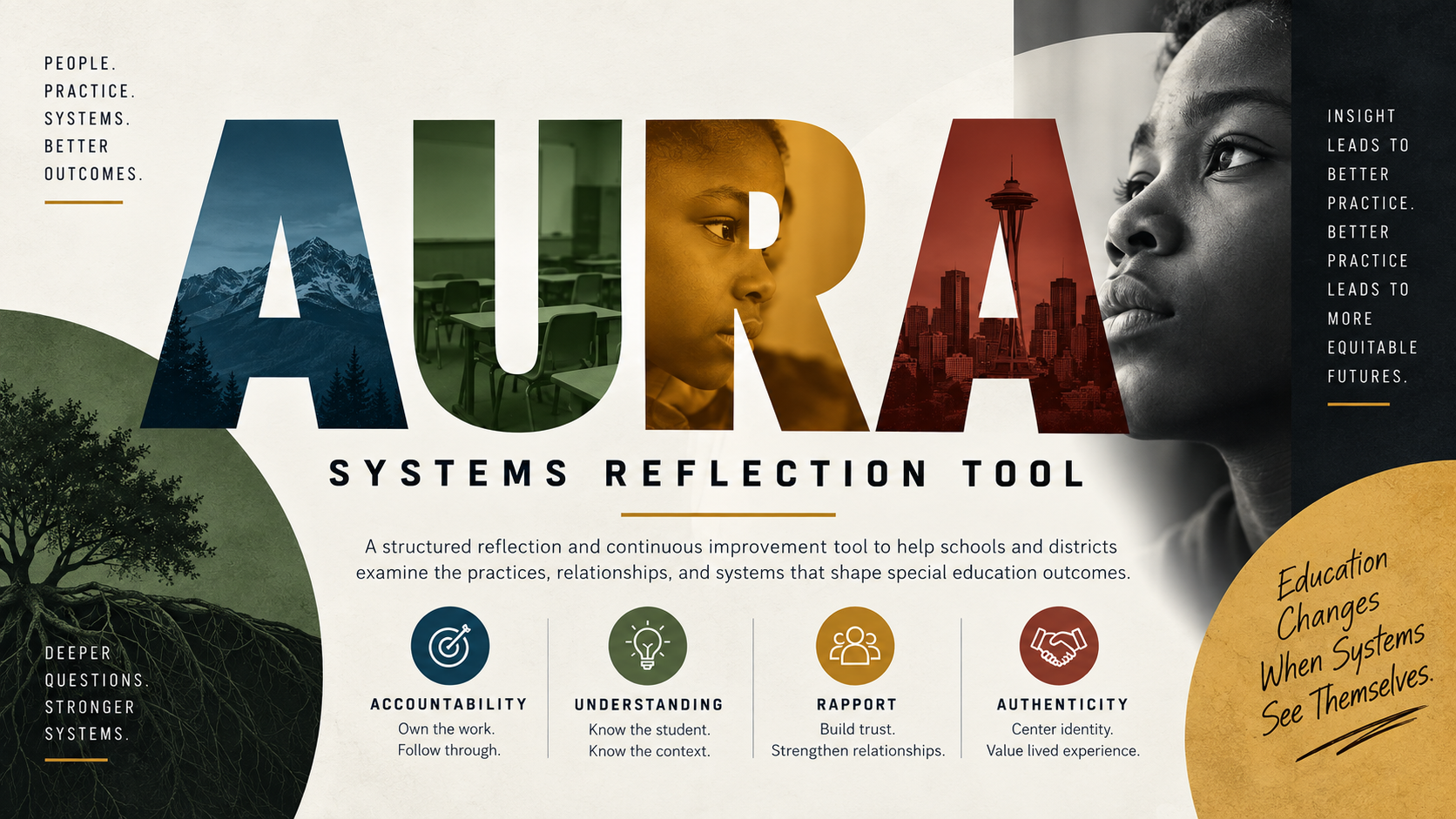
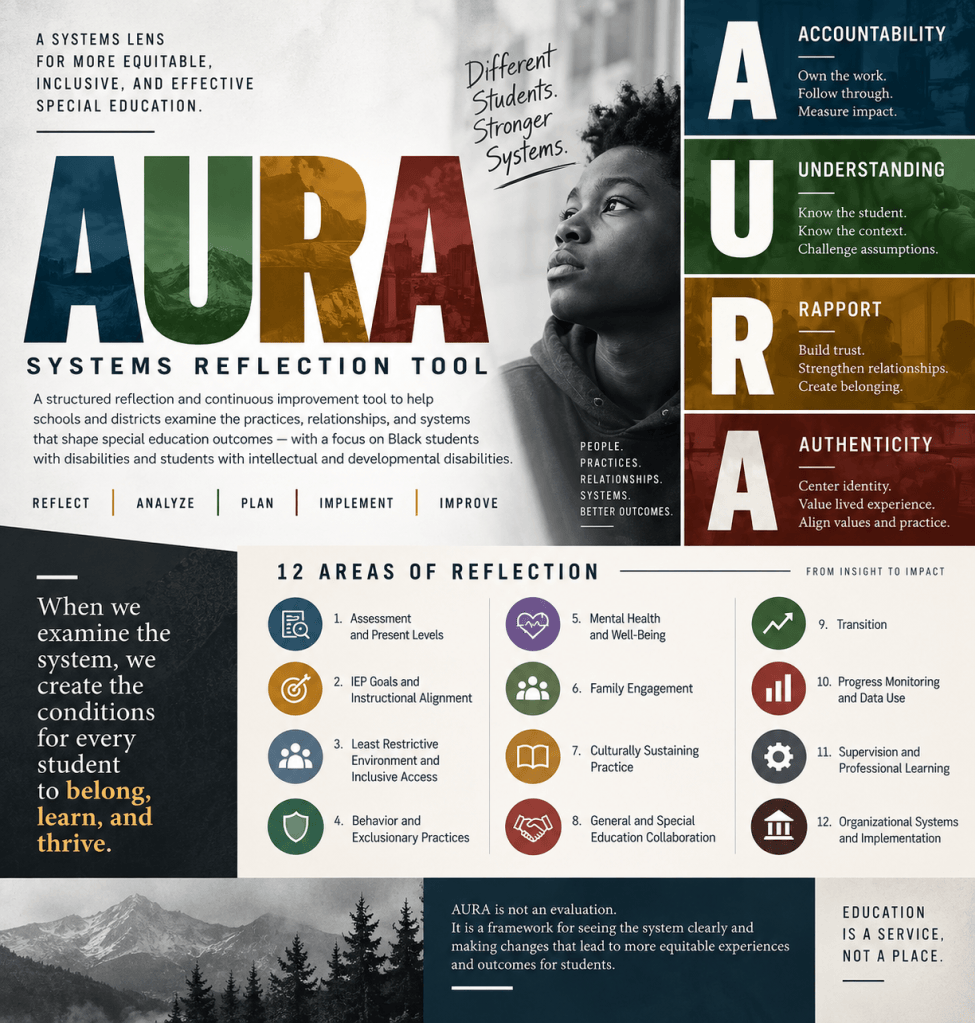
The framework that eventually emerged from this thinking became AURA: Accountability, Understanding, Rapport, and Authenticity. Each dimension represents an element of systems practice that I had encountered repeatedly across different educational settings. Accountability concerns the relationship between commitments, decisions, implementation, and outcomes. Understanding requires educators and systems to develop sufficient knowledge of students, disability, culture, instruction, family, history, and context before interpreting student performance or behavior. Rapport recognizes relationships and trust as conditions that influence teaching, learning, communication, family partnership, and belonging rather than treating them as secondary interpersonal qualities. Authenticity examines whether commitments to culture, identity, inclusion, student voice, and family partnership meaningfully influence decisions and practice.
As AURA developed, the framework expanded beyond those four foundational concepts into a structured systems-reflection process encompassing 12 interconnected areas of special education practice. These areas include assessment and present levels, IEP goals and instructional alignment, least restrictive environment and inclusive access, behavior and exclusionary practices, mental health and well-being, family engagement, culturally sustaining practice, general and special education collaboration, transition, progress monitoring and data use, supervision and professional learning, and organizational systems and implementation. The purpose of examining these areas together is not to suggest that every educational problem originates at the organizational level. Rather, it recognizes that student experiences are produced through interactions among multiple levels of a system, and understanding those experiences requires examining more than one level at a time.
This is also why AURA is intentionally designed as a non-evaluative reflection and continuous-improvement tool rather than an employee evaluation or compliance audit. Blame is a poor systems-improvement strategy because it can reduce complex organizational problems to the perceived shortcomings of individual people. Avoiding blame does not mean avoiding accountability. In fact, meaningful accountability requires considerably more than identifying someone responsible for a poor outcome. It requires determining what conditions allowed that outcome to occur, what evidence informed the decisions that preceded it, whether established practices were implemented as intended, what perspectives were absent from the process, and what adults and organizations will do differently as a result.
AURA therefore asks teams to examine evidence from multiple perspectives. District leaders, school leaders, educators, students, and families do not occupy the same position within an educational system and consequently do not experience it in the same way. A district may believe a practice is well established because guidance has been distributed and professional development has occurred, while educators may report inconsistent implementation and families may describe an entirely different experience. None of those perspectives alone provides a complete picture. Examining the differences among them can reveal the distance between organizational intention and lived experience, which is often where meaningful opportunities for improvement become visible.
The framework intentionally centers Black students with disabilities and students with intellectual and developmental disabilities because aggregate measures of improvement can conceal persistent inequities. A district may improve an overall least restrictive environment measure while a particular student population experiences little or no movement. Similarly, placement data can indicate where a student spends the school day without explaining the quality of instruction, participation, relationships, agency, or belonging experienced within that placement. For this reason, AURA treats outcome data as one form of evidence within a larger inquiry into how systems function.
This distinction has become increasingly central to my work: placement is not synonymous with inclusion, compliance is not synonymous with quality, and intention is not synonymous with impact. Educational systems frequently measure what is easiest to quantify, even when those measures cannot fully explain what students experience. AURA is intended to help connect those different levels of evidence by examining the relationship among organizational structures, adult practices, student and family experiences, and measurable outcomes.
The process must ultimately lead to action. Reflection without implementation risks becoming another institutional exercise in which organizations become increasingly sophisticated at describing inequity without changing the conditions producing it. Once a team identifies a concern, the next questions involve determining which practices or conditions are contributing to it, what evidence supports that conclusion, what is realistically within the organization’s control, what actions should be prioritized, who will be responsible for implementation, and what evidence will demonstrate that practice has actually changed. Annual outcome measures remain important, but organizations should not have to wait an entire year to determine whether adults are doing something differently. Implementation itself can and should be examined.
This is where I see the clearest connection between the systems thinking documented in my 2019 graduate-school project and the AURA framework that exists today. The final project was not AURA, and I do not want to rewrite history by pretending that the completed framework existed seven years ago. It did not. What the project documents is the intellectual foundation from which AURA eventually developed: an understanding that educational outcomes cannot be separated from the systems surrounding students, that culture and power influence educational decision-making, that relationships with families require attention to reciprocity rather than paternalism, and that changing outcomes requires adults and institutions to examine their own practices.
AURA represents the continued development of that thinking through years of professional practice. The framework became more sophisticated as my work expanded across classrooms, IEP teams, families, schools, districts, community organizations, and statewide systems. Concepts that began as questions became areas of reflection. Areas of reflection became indicators of practice. Those indicators eventually developed into a structure through which teams can examine evidence, identify strengths and gaps, establish priorities, implement changes, and return to the evidence to determine whether those changes made a difference.
For me, that history matters because AURA is not a framework I created simply because educational systems needed another tool. There are already more than enough tools that are introduced, briefly implemented, and eventually replaced by the next initiative. AURA grew from a much longer effort to understand why educational systems can know that inequity exists, possess considerable data demonstrating that it exists, publicly commit themselves to addressing it, and still struggle to change the everyday experiences producing those outcomes.
The question I was beginning to wrestle with in graduate school remains the question underneath AURA today: What are we willing to examine about the system when the outcomes tell us that the system is not working equally well for every child?
AURA provides a structure for doing that examination with enough depth to move beyond diagnosis and toward action. Its purpose is not to locate another deficit within a child, family, teacher, or school. Its purpose is to make the relationships among decisions, practices, conditions, experiences, and outcomes visible enough that educators and systems can determine what needs to change.
That is why the phrase I use to describe AURA has become more than a tagline to me. It captures a way of thinking that began long before the tool itself existed:
See the system clearly enough to change it.
 Thoughts Processed