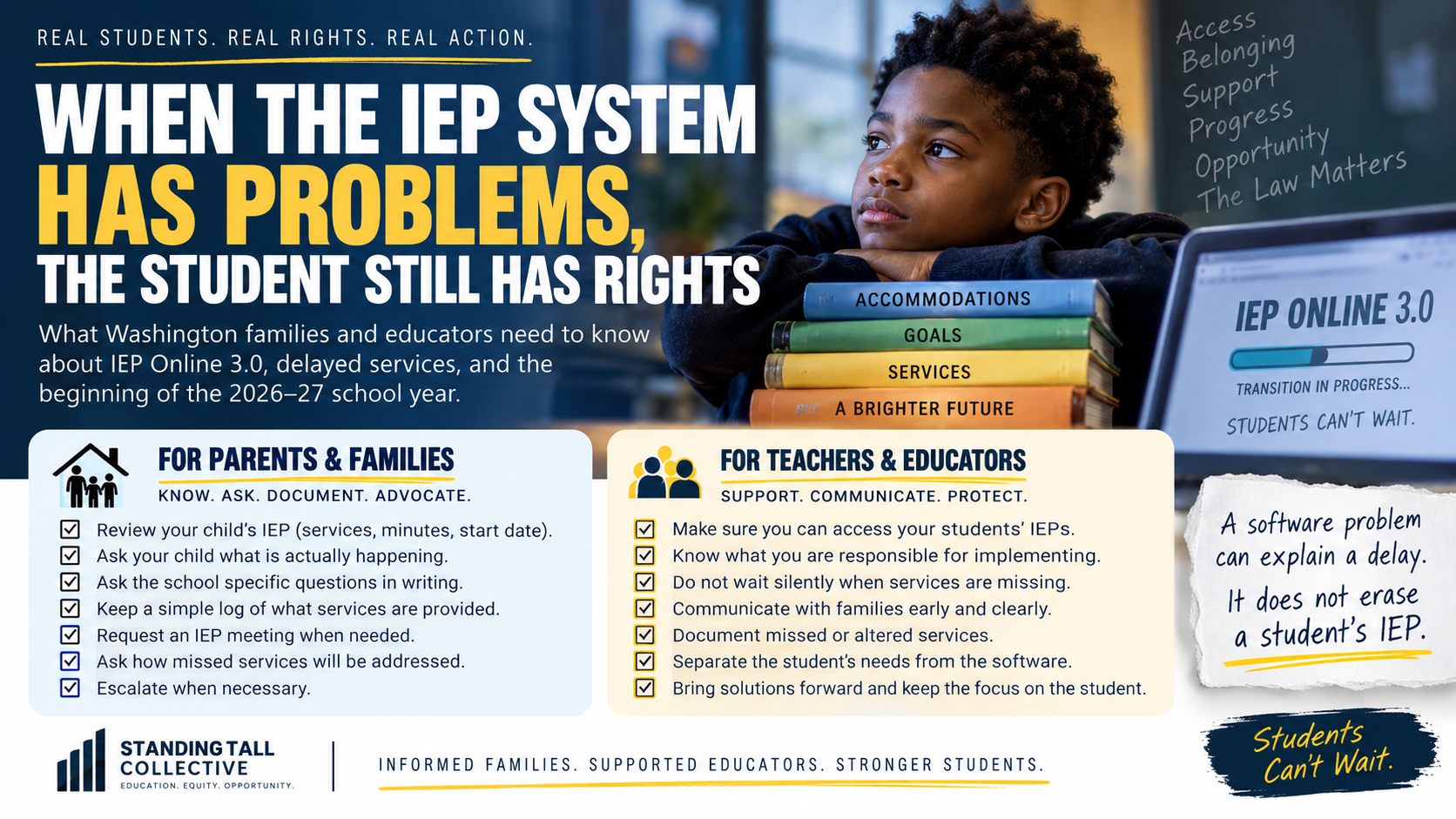


The technology can change. The student’s needs do not.
The beginning of a school year is already complicated. Schedules change. Staff move. Caseloads shift. New students enroll. Transportation gets worked out. Teachers are trying to learn names, needs, routines, accommodations, goals, and family expectations, often all at once.
This year, some Washington special education teams have another challenge layered on top of all of that: the transition to IEP Online 3.0.
On September 11, 2026, the Washington Office of Superintendent of Public Instruction acknowledged that some educators and IEP teams are experiencing questions and challenges as districts transition to WSIPC’s IEP Online 3.0 system. OSPI directed districts using the platform to continue working with WSIPC and the vendor for technical assistance. Read OSPI’s September 2026 Special Education Update.
That deserves attention. It also requires an important distinction:
A technology problem can explain why something went wrong. It does not change what a student is entitled to receive.
Washington law says that at the beginning of each school year, a district must have an IEP in effect for every eligible student it serves. The IEP must also be accessible to the general education teachers, special education teachers, related-service providers, and other personnel responsible for implementing it. Those educators must be informed of their specific responsibilities, including the accommodations, modifications, and supports they are responsible for providing. See WAC 392-172A-03105.
The responsibility does not begin when the software works perfectly. It begins when the student walks through the door.
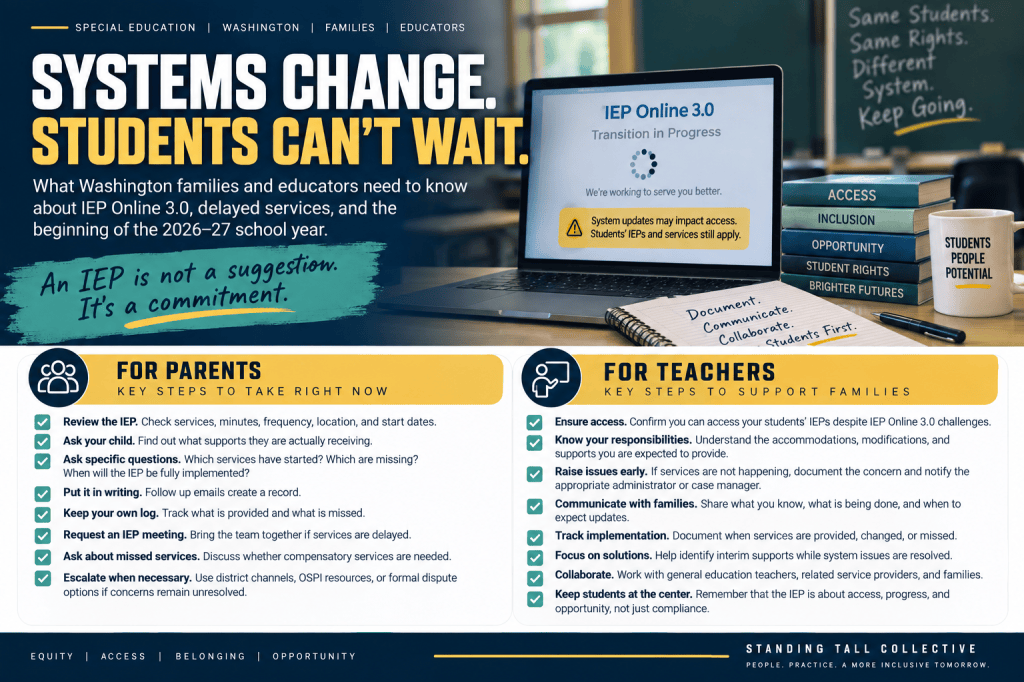
First, understand what OSPI is actually saying
There are two related issues happening at the same time, and they should not be confused.
IEP Online 3.0 is a WSIPC system being used by participating districts. It is not the future statewide IEP platform that OSPI is separately developing. OSPI says the future statewide system is a multi-year project, with pilot implementation currently expected to begin during the 2028–29 school year.
OSPI has also published September 2026 guidance addressing meeting requirements during the IEP Online 3.0 migration. OSPI’s special education policy, guidance, and resources page is available here.
None of that changes the underlying requirement. A student’s IEP includes the projected beginning date of services, along with the anticipated frequency, location, and duration of those services. See WAC 392-172A-03090.
So when a family hears, “We haven’t started special education yet,” “We’re still working on the schedule,” “The new IEP system isn’t working correctly,” or “We’re waiting for everything to transfer over,” those statements may describe a real operational problem.
They should also lead to another question:
What is being done right now to make sure the student still receives what is in their IEP?
What Parents Should Do
1. Pull out the current IEP
Do not rely only on what somebody remembers from last year. Look at the actual document. Find the sections describing special education services, related services, service minutes, frequency, location, accommodations, modifications, supplementary aids and services, and the projected start date for services.
2. Ask your child what is actually happening
The paperwork tells you what is supposed to happen. Your child can sometimes tell you what is happening. Depending on age and communication needs, ask questions such as: Who do you work with during math? Have you seen your speech therapist yet? Where do you go during your support period? Are teachers letting you use the supports in your IEP?
Do not turn this into an interrogation. You are simply comparing the written plan with the student’s actual experience.
3. Ask the school specific questions
- Which IEP services have begun?
- On what date did each service begin?
- How many service minutes has my child received so far?
- Have any scheduled services been missed?
- Are all teachers who work with my child able to access the current IEP?
- Have those teachers been informed of their responsibilities, accommodations, modifications, and supports?
- If services have been delayed, what is the district’s plan for addressing that delay?
4. Put important communication in writing
A hallway conversation or phone call can be helpful, but neither creates the same record as a written follow-up. After a conversation, send a short email confirming your understanding of what has or has not occurred and asking how missed services will be addressed.
5. Keep your own service log
Parents should not have to become compliance officers for school districts. Still, when there is a known implementation problem, documentation matters. A simple log with the date, service expected, service received, minutes, and notes can help identify whether a problem is isolated or becoming a pattern.
6. Request an IEP meeting when the issue needs the team
Parents are members of the IEP team. If services have been missed, the student’s needs have changed, or the implementation problem is affecting educational progress, asking the team to meet can be appropriate. Washington requires districts to provide parents an opportunity to participate in IEP meetings. See WAC 392-172A-03100.
7. Ask how missed services will be addressed
Do not assume every missed minute automatically creates an identical minute of compensatory education. Compensatory education is an individualized remedy, and the analysis can involve the nature of the missed services and their effect on the student’s access to FAPE.
Families can still ask: What was missed? What impact did that have? Does the student need additional services or another remedy because the IEP was not implemented as intended?
8. Escalate when necessary
Most problems should first be addressed as close to the student as possible: the case manager, related-service provider, school administrator, special education administrator, or IEP team. When meaningful concerns remain unresolved, Washington families also have formal dispute-resolution options through the special education system. OSPI’s special education family resources are available here.
Parent Checklist
- Review the current IEP.
- Check services, minutes, frequency, location, accommodations, related services, and start dates.
- Ask your child what support they are actually receiving.
- Ask which services have started and when.
- Ask whether any services or minutes have been missed.
- Put important questions and responses in writing.
- Keep a simple record of services received or missed.
- Ask how missed services will be addressed.
- Request an IEP meeting if the concern cannot be resolved informally.
- Keep the focus on what the student needs, not simply what went wrong.
What Teachers Should Do
This conversation cannot become another version of “parents versus schools.” Teachers are often the people stuck between the student, the family, the district system, staffing shortages, scheduling decisions, and technology they did not choose.
That does not make teachers powerless. In many cases, the teacher is the person who can identify the problem first.
1. Make sure you can actually access your students’ IEPs
If you cannot access an IEP because of IEP Online 3.0 or another system problem, say something immediately. Do not normalize working blind. Contact the appropriate special education administrator, case manager, building administrator, or district support person and document that you requested access.
Technology problems need technical solutions. Students still need educational solutions in the meantime.
2. Know what you personally are responsible for implementing
Reading an IEP and implementing an IEP are not the same thing. Teachers should know the accommodations, modifications, specially designed instruction, behavioral supports, communication supports, assistive technology, testing accommodations, relevant health or safety supports, and progress-monitoring expectations connected to their role.
3. Do not wait silently for the system to get fixed
If a student is supposed to receive a support and you know it is not happening, raise the issue. Do not assume somebody else is handling it. Systems become dangerous when everybody assumes somebody else is responsible.
4. Tell families what you know without creating panic
Families should not discover six weeks later that a service never started. Educators also should not speculate or give parents information they cannot verify. Communicate what you know, what is being done, and when the family should expect another update.
5. Separate the student’s needs from the software
An electronic IEP system is a tool for documenting and managing the program. The software is not the program. The student’s goals still exist. The accommodations still matter. The student still needs specially designed instruction. The family is still part of the team.
6. Track missed or altered services
Teachers and service providers should document when services are provided, interrupted, changed, or missed. That information helps teams later determine whether the problem was minor, significant, isolated, or persistent. Good documentation also protects teachers.
7. Bring families into the solution
Family engagement should not begin once somebody threatens a complaint. If a service problem exists, explain what happened, what is known, what is still being determined, who is working on it, what interim support is being provided, and when the family should expect another update.
8. Remember the general education classroom
IEP implementation is not solely the responsibility of the special education teacher. Washington specifically identifies general education teachers among the educators who must have access to the IEP and understand their implementation responsibilities. An accommodation used in English, science, history, PE, or mathematics does not disappear because the special education teacher is somewhere else.
Teacher Checklist
- Confirm you can access every IEP you are responsible for implementing.
- Know your specific responsibilities for accommodations, modifications, supports, and SDI.
- Raise access or implementation problems immediately.
- Do not wait silently for a software problem to resolve itself.
- Document missed, altered, or interrupted services.
- Communicate concerns to the appropriate case manager or administrator.
- Tell families what you know without speculating.
- Explain what is being done to address the issue.
- Make sure general education teachers understand their responsibilities too.
- Keep asking: what support does this student need right now?
What School Leaders Should Be Asking
If I were leading a school or district through an IEP platform transition right now, I would want answers to four questions:
- Which students currently have IEP implementation risks because of this transition?
- Can every educator responsible for implementation access the information they need?
- Do we know which services have not started or have been interrupted?
- How are we communicating with affected families?
This should be treated as a systems problem, not a collection of individual teacher failures. A district can have hardworking teachers and still have an implementation problem. Both things can be true.
Do Not Let Compliance Become the Goal
Special education can become so paperwork-driven that we forget what the paperwork represents.
An IEP is not valuable because somebody successfully entered it into the correct boxes in a computer program. It is valuable because it represents an agreement about what a particular student needs to access education and make progress.
A perfectly compliant document that nobody implements does not serve a child. A sophisticated software platform cannot build relationships with families. A dropdown menu cannot provide specially designed instruction. A database cannot notice when a student is struggling and say, “Something isn’t working. We need to change this.”
People do that. Teachers do that. Families do that. IEP teams do that.
One Question for Families and Educators
As Washington districts work through the transition to IEP Online 3.0, families should not panic, and educators should not be blamed for every systems problem. Everybody should be paying attention.
Pull out the IEP. Know what it says. Know who is responsible. Document what is happening. Communicate early. Fix problems when they are small. Bring the IEP team together when necessary.
Is this student’s IEP actually being implemented as written?
If the answer is no, the next question should not be about whose fault it is.
What are we going to do about it?
This article provides educational information about Washington special education requirements and is not individualized legal advice. Families with specific disputes may want to consult OSPI’s family guidance and procedural safeguards or obtain individualized advocacy or legal support.
 Thoughts Processed